

Parle mascot

Pronunciation

Finally nail the French R, U, and nasal vowels

Parle listens to your recording and tells you exactly which sound missed the mark — no guessing, no vague "try again."

Sound-by-sound scoring

See which specific sound needs work, not just a pass/fail.

Native comparison

Hear your recording side-by-side with a native speaker.

Track your progress

Watch your accuracy improve phrase by phrase.

The 3 sounds English speakers miss most

Get these three right and your French instantly sounds more natural. They are also the sounds Parle users practise the most.

[ʁ]

The French R

Made at the back of the throat, close to a soft gargle. It is nothing like the English R.

Common mistake: Curling the tongue tip like an English R, or rolling it like a Spanish R.

How to practise it

  1. Keep the tip of your tongue down, behind your lower teeth.
  2. Raise the back of your tongue towards the soft palate, as if starting a "k".
  3. Let air rub through that narrow gap with a light, breathy friction.
  4. Start with "ra, ré, ri", then words like "rouge", "Paris" and "très".

Practise with: rouge, Paris, très, merci, parler
[y]

The French U

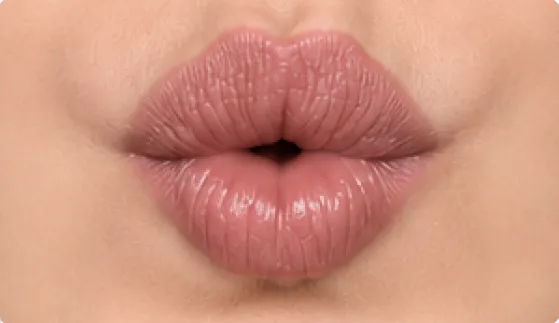
A sound English does not have: the tongue says "ee" while the lips say "oo".

Common mistake: Saying "oo", which turns "tu" (you) into "tout" (all) and "dessus" into "dessous".

How to practise it

  1. Say a long "ee" and feel your tongue high at the front.
  2. Without moving your tongue, round your lips into a small tight circle.
  3. Hold it: that is [y]. Check it in a mirror or in Parle.
  4. Practise the pairs "tu / tout" and "rue / roue".

Practise with: tu, rue, plus, salut, une

Mouth position for the French vowel [y], as in tu, rue, plus, salut, une

[ɑ̃ ɔ̃ ɛ̃]

The nasal vowels

Air flows through the nose and the mouth at the same time. The N or M after the vowel is not pronounced.

Common mistake: Adding a final N: "bonjour" becomes "bon-n-jour" and "vin" sounds like "van".

How to practise it

  1. Say the plain vowel first: "a" for [ɑ̃], "o" for [ɔ̃], "è" for [ɛ̃].
  2. Lower your soft palate so part of the air escapes through your nose.
  3. Stop the sound before your tongue touches the roof of your mouth. No N.
  4. Contrast "sans / son / saint" until each one is clear.

Practise with: sans, enfant, bonjour, vin, pain

Mouth position for the French vowel [ɑ̃ ɔ̃ ɛ̃], as in sans, enfant, bonjour, vin, pain